Research Library
Scientific Background & Laboratory Reference
A comprehensive reference library documenting the molecular mechanisms, synthesis methodologies, and preclinical research context for every compound in our catalog.
Each profile below contains chemical identification data, mechanism of action summaries, and stability notes drawn from peer-reviewed literature and laboratory evaluations.
All information in this library is drawn from preclinical research literature and is provided for educational and informational purposes only. It does not constitute medical advice, imply therapeutic outcomes, or endorse any specific application. These compounds are sold strictly for laboratory research use.
Section 01
What Are Research Peptides?
Bioactive peptides represent a highly specialized and rapidly expanding class of biological molecules consisting of short, specific chains of amino acid residues linked by covalent peptide bonds. In contemporary laboratory and preclinical research contexts, these compounds are investigated extensively for their diverse array of physiological interactions, regulatory functions, and structural properties. Ranging typically from simple dipeptides containing two amino acids to highly complex macromolecular structures containing up to fifty amino acids, peptides occupy a critical and highly functional biochemical space between small organic molecules and large, complex tertiary proteins.
Due to their endogenous nature, these peptides have demonstrated a remarkably high degree of target specificity and binding affinity when applied to in vitro cellular models. The fundamental nature of peptides as the primary biological building blocks of cellular machinery allows molecular researchers to utilize them as targeted synthetic analogues. The discovery of these myriad biological activities—ranging from blood pressure regulation and antimicrobial activity to the modulation of inflammatory pathways—has driven an exponential increase in laboratory interest.
Section 02
Laboratory Synthesis Methodologies
While biologically active peptides are ubiquitous in nature, they are generally produced by organisms in minute, transient quantities that are insufficient for rigorous empirical study. Consequently, the advancement of modern peptide science is entirely reliant on highly sophisticated, scalable laboratory synthesis techniques. Present-day synthesis primarily relies on Solid-Phase Peptide Synthesis (SPPS), a revolutionary methodology that enables the systematic, high-yield construction of custom peptide sequences on a macroscopic scale suitable for intensive research.
The fundamental chemical principle of SPPS involves the covalent attachment of the nascent peptide chain to an insoluble polymeric support resin. This critical anchoring mechanism allows the peptide assembly chemistry to proceed in a controlled, homogenous solution phase while simultaneously facilitating the rapid removal of excess reagents and reaction byproducts through simple, repetitive filtration and washing steps. The peptide molecule is constructed sequentially, progressing exclusively from the C-terminus to the N-terminus.
Section 03
Purification and Structural Characterization
Crude peptides synthesized for experimental purposes inevitably contain closely related chemical impurities resulting from incomplete coupling reactions, sequence truncation, or unintended side-chain modifications. For rigorous preclinical research, binding affinity assays, and structure-activity relationship (SAR) investigations, research peptides must generally demonstrate a purity threshold of 95% or greater.
Purification is predominantly achieved through preparative Reverse-Phase High-Performance Liquid Chromatography (RP-HPLC). Following isolation and subsequent re-lyophilization, rigorous analytical characterization is mandatory for laboratory compliance. Absolute structural confirmation is obtained via highly sensitive mass spectrometry, utilizing advanced techniques such as Electrospray Ionization Mass Spectrometry (ESI-MS) or Matrix-Assisted Laser Desorption/Ionization (MALDI-MS).
Compound Profiles
Research Compounds Library
BPC-157
CAS: 137525-51-0
MW: 1419.5 Da
TB-500 (Thymosin Beta-4 Acetate)
CAS: 77591-33-4
MW: 4963.49 Da
Tirzepatide (GLP2-T)
CAS: 2023788-19-2
MW: 4813.45 Da
Retatrutide (GLP3-R)
CAS: 2381089-83-2
MW: 4731.33 Da
Glutathione
CAS: 70-18-8
MW: 307.33 Da
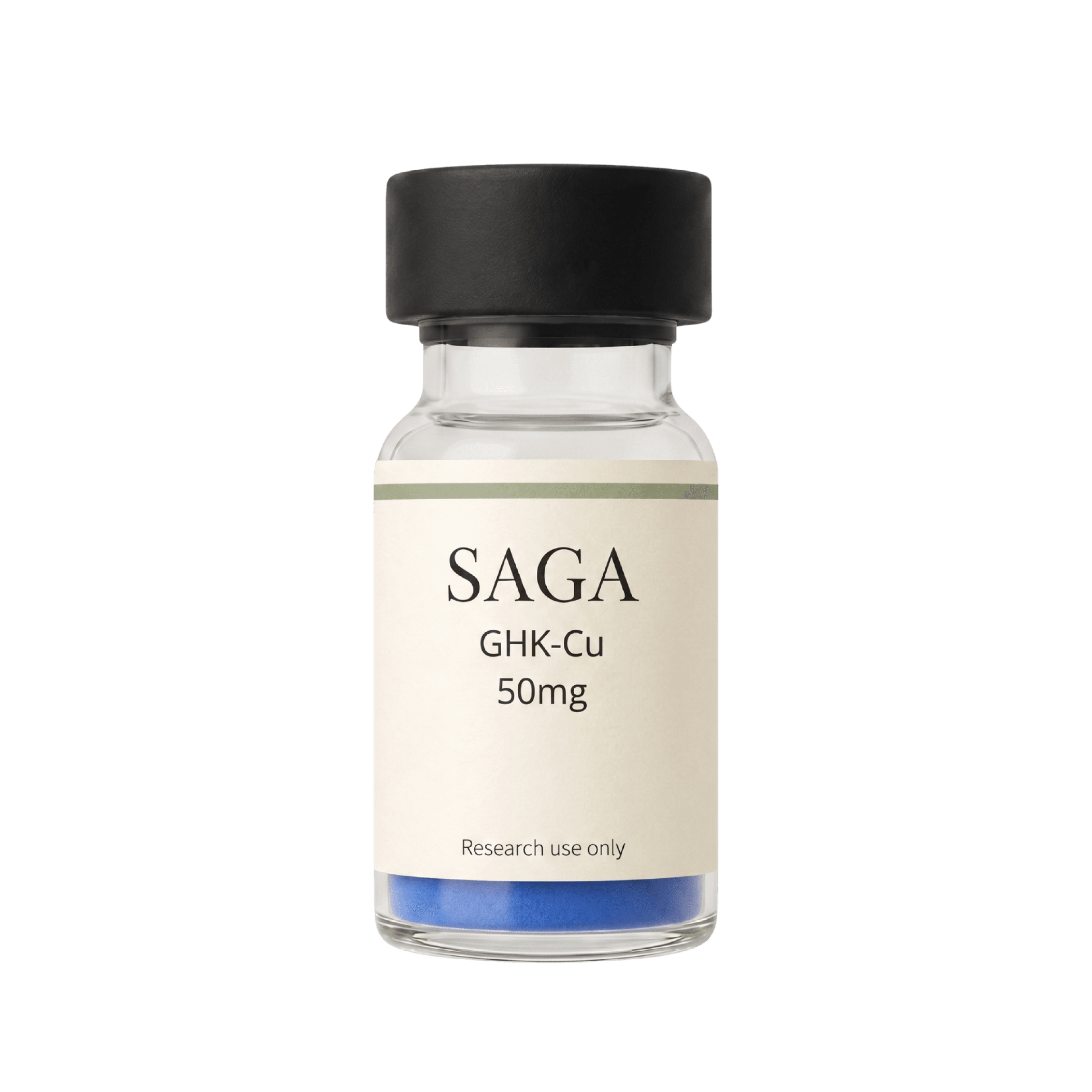
GHK-Cu
CAS: 300801-03-0
MW: 744.3 Da (Complex) / 403.92 Da (Monocopper salt)
CJC-1295 (NO DAC)
CAS: 446033-06-3
MOTS-c
CAS: 1627580-64-6
Tesamorelin
CAS: 218949-48-5
MW: 5135.86 Da
Ipamorelin
CAS: 170851-70-4
MW: 711.85 Da
NAD+ (Nicotinamide Adenine Dinucleotide)
CAS: 53-84-9
MT-2 (Melanotan II)
CAS: 121062-08-6
MW: 1084.2 Da
Sermorelin
CAS: 86168-78-7
MW: 3357.9 Da
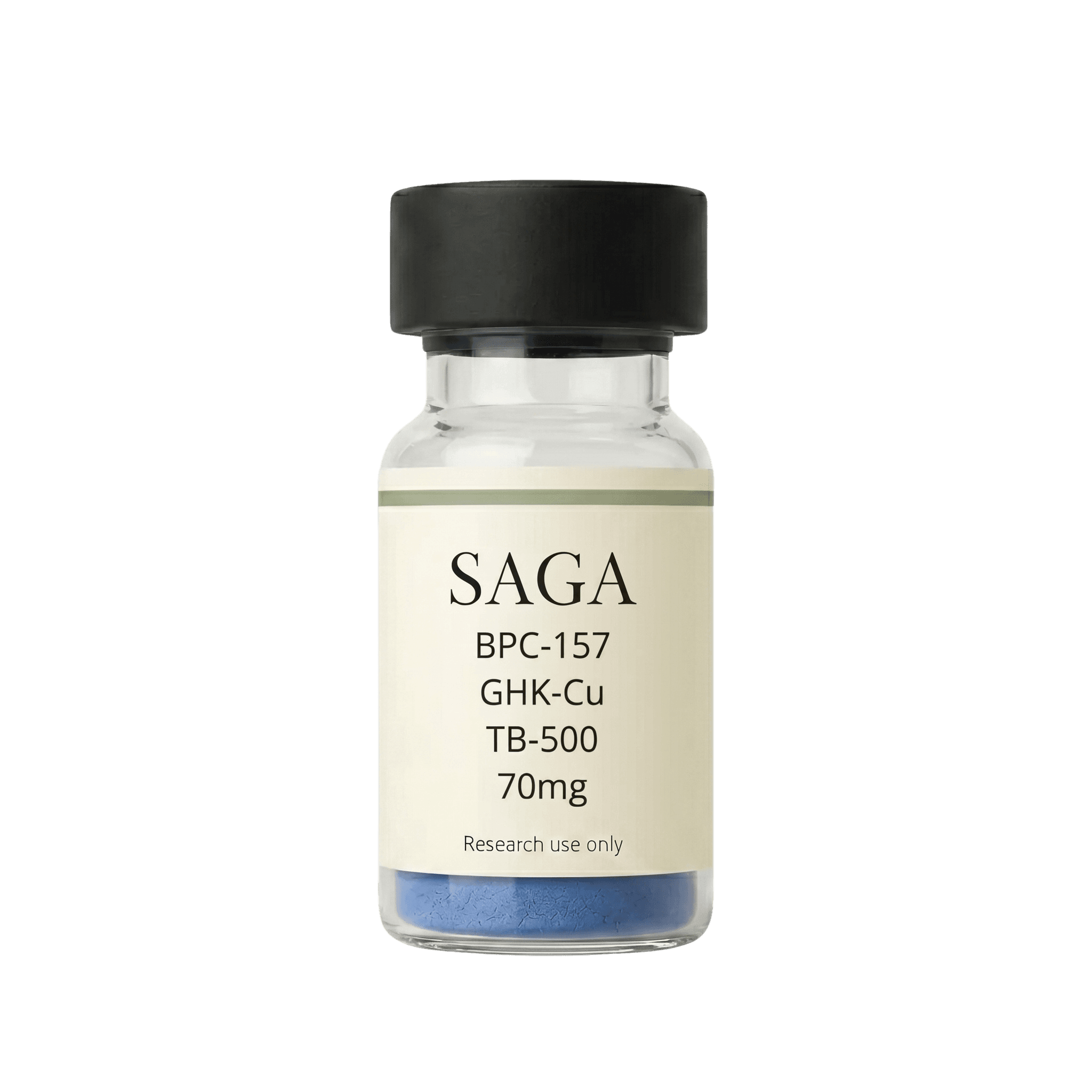
GLOW Blend (BPC-157 + GHK-Cu + TB-500)
70mg per vial
Wolverine Blend (BPC-157 + TB-500)
20mg per vial
Ready to explore our catalog?
Every compound in our library is available for purchase with batch-specific Certificates of Analysis and cold-chain shipping.